Fermenting
Kombucha Tea
Ingredients:
- 1 gallon water, divided
- 3 tablespoons (or 6 tea bags) black tea
- 1/3 cup + 2 tablespoons (or 13 tea bags) green tea
- 1 cup granulated sugar
- 1 SCOBY with starter liquid
Instructions:
- If this is your first time brewing kombucha, review What's the Word on Homemade Kombucha? and Kombucha FAQ before you start.
- Clean the kitchen area and wash hands with soap and water for at least 20 seconds.
- Wash and rinse equipment with soap and water. Submerge cleaned equipment in hot water (at least 171°F) for at least 30 seconds to sanitize.
- Measure the pH of the starter liquid.
- Heat 4 cups of water to 160° - 170°F (use a food thermometer to check), and add the tea to steep for 2 minutes.
- Remove the tea bags or strain loose-leaf tea. Pour the tea into your fermentation container and add sugar. Stir to dissolve.
- Add 12 cups of cold water and stir. Take the temperature of the tea to make sure it is below 95°F before proceeding to step 8.
- Add the SCOBY and starter liquid and stir well for 10 seconds.
- Dry the opening of the container, then cover with a paper towel, coffee filter, or clean cheese cloth and secure with a rubber band or string.
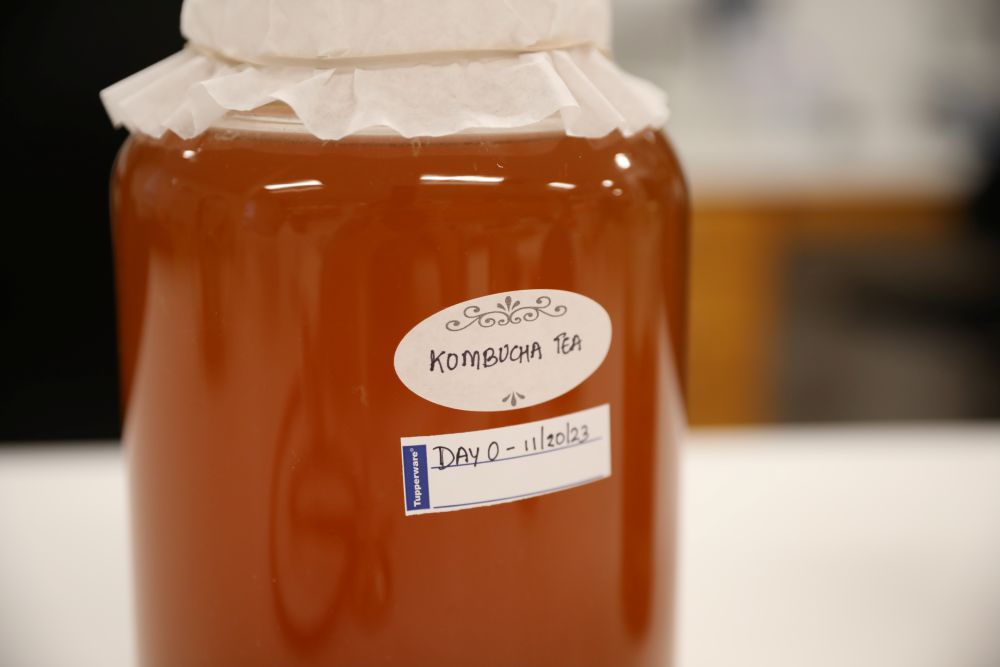
- Mark the container with the date (this is Day 0 of the fermentation) and allow the kombucha to ferment at room temperature (68° - 77°F) for 7 – 10 days.
- Once the kombucha tea has fermented fully, pour it into clean and sanitized jars or bottles and promptly refrigerate. Use within 30 days. Caution – Storing kombucha in airtight containers can cause the accumulation of CO2 (carbonation), potentially leading to an explosion if not regularly monitored.
Yield: 27 – 34 4-ounce servings
Serving Suggestions (after fermentation):
If mixing additional ingredients (after fermentation), drink immediately or refrigerate for up to 2 days.
- Greens – muddle the kombucha with fresh mint or lemon balm and serve over ice. Garnish with cucumber slices.
- Fruits – blend the kombucha with your favorite fruits and ice.
- Roots – Mix kombucha with fresh or dried ginger, add honey, and serve over ice.
- Greens + Fruits – Mix kombucha with pureed strawberries and basil. Serve over ice.
How to measure pH of the starter liquid:
- Place 1 tablespoon of starter liquid in a small bowl or cup.
- Use a pH strip or litmus paper to measure the pH of the starter liquid. Follow the instructions from the test paper manufacturer.
- Check the test paper:
- If the pH is 4.0 OR LESS, proceed to step 4 of the instructions above, discarding the starter liquid that you tested.
- If the pH is GREATER THAN 4.0 do not make kombucha with the starter liquid. You will need fresh starter liquid or the fermentation process may be compromised. Discard.
Interested in how the safety factors for this recipe were determined? See the article Determining Critical Food Safety Factors for Safely Homebrewing Kombucha: A Study on Microbial Survivability in Food Protection Trends.
This research was conducted as a collaboration between University of Georgia Food Science and Technology, Kansas State University Food Science Institute, and University of Georgia Nutritional Sciences.
Recent Content
Can Splenda® (sucralose) be used in preserving food?
Granular Splenda® does not provide preservative properties like sugar.
Canning Fruits: Whereas we do not have published research work with using sucralose in the canning of fruits at home available to us, it is possible to use it for sweetening the water used to cover fruits when canning. The texture and color preserving aspects of a sugar syrup will not be provided. The result would be like canning in water except for the additional sweetness contributed by the Splenda®. The USDA fruit canning directions do allow for canning in water (i.e., without a sugar syrup), as there is adequate preservation for safety from the heat of proper canning. Some people do notice an aftertaste in other products and canned fruits, and it is possible some little changes in natural flavors may occur over storage time, since sugar can mask some of these. For people used to sucralose sweetening and flavors, the aftertaste may not be an issue. Based on some of our experiences in canning peaches and pickled foods, we suggest you start seeing what you like by trying less than a full substitution for the sugar in canning syrups. For example, if you use a medium sugar syrup that is 5-/14 cups water to 2-1/4 cups sugar, try 1 to 1-1/4 cups Splenda® the first time. You can always sweeten more when you serve the finished product if it is not quite sweet enough; then you can increase the canning liquid amount the next time you can.
Preserves and Pickled Fruits: In other cases, where sugar is important, like some preserves or pickled fruits, it is not recommended that substitution of Splenda® be used for sugar if the product is to be canned for shelf stability. Splenda® cannot be used in several traditional Southern preserves we have on this website or in the University of Georgia Extension publications. These are whole or uniform pieces of fruit in a very thick sugar syrup, usually made with figs, peaches or pears. (These preserves are not jam or pectin gel products.) Sugar is required for the preservation of these syrupy fruit preserves as published, with very short boiling water canner processes. Without that heavy amount of sugar, these products become fruit pieces canned in water or lighter sugar syrups, and the usual (and longer) fruit canning process times and preparation directions would need to be used.
Jams and Jellies, or Fruit Spreads: You could use Splenda® as the optional sweetener in a jam or jelly made with a no-sugar needed pectin, such as Mrs. Wages™ Lite Home Jell® Fruit Pectin, Ball® No-Sugar Needed Pectin or Sure-Jell® for Less or No-Sugar-Needed Recipes. With these low-methoxyl pectins, no sugar is required at all. Sugar substitutes can be added as desired simply for flavor. The package inserts with these pectins give instructions on when to add the sugar substitutes (usually after all the cooking, right before filling the jars). Do not try to substitute Splenda® for the required sugar in recipes calling for “regular” liquid and powdered pectins.
And do not try to substitute Splenda® in long-boil or no-pectin-added jams and jellies intended for room temperature storage as a canned product. You might get some thickened fruit spreads with just fruit and Splenda®, but they may not have enough water control for processing like a gelled, high sugar-containing jam or jelly. They might require longer processing to avoid spoilage at room temperature. If you want to experiment with making these kind of fruit spreads we recommend freezing or refrigeration for storage.
We have developed three recipes using Splenda® and they are on our website, www.homefoodpreservation.com. They are quick pickled sweet cucumber slices, pickled beets and pickled cantaloupe. They are under the How do I....Pickle category, as well as National Center factsheets, http://www.uga.edu/nchfp/publications/nchfp/factsheets.html.
There is also a Peach-Pineapple Reduced Sugar Fruit Spread from the USDA Complete Guide to Home Canning that does not require added sugar. Some other fruit substitutions are provided in the text. The suggested sugar for sweetening can be left out, or you can add some Splenda® as desired for sweetness. The process time is longer than regular jams and jellies, and is like that for a fruit puree. http://www.uga.edu/nchfp/how/can_07/peach_pineapple_spread.html
How can I become a Master Food Preserver?
“Master” volunteer programs that are connected to the Cooperative Extension System, such as Master Food Preservers and Master Gardeners, are currently state- or county-managed programs affiliated with the land grant universities and the Cooperative Extension Service in the state. In exchange for extensive education, the master volunteer returns contributions to the local Extension office, such as answering phone calls, developing and hosting exhibits, judging at competitions, etc. There are liabilities involved in someone conducting even volunteer work in the name of a state university; therefore, the guidelines and management procedures will vary among states. At this time, the National Center is not in a position to help individuals meet state guidelines for credentials and the title of Master Food Preserver.
If you would like to find out if your state offers this opportunity to become a Master Food Preserver, contact your local Extension Office (usually listed in local government pages of the phone book under Cooperative Extension Service, Ag Extension Office and/or 4-H Office). You could also contact someone at the state university to either ask your questions or let them know of your interest. These contacts can be found on a website managed by USDA:https://www.nifa.usda.gov/grants/programs/agriculture-food-research-initiative-afri/food-safety-nutrition-health-program-area
Most states do not sell their Master Food Preserver curricula or notebooks to the general public. If someone wants information on preserving, they have other publications available with the actual recommendations and procedures. This website from the National Center is full of “How To” information for various types of food preservation. We will eventually have tutorials and a correspondence type course on line for self-study.
Is it necessary to thaw meat or fish before cooking?
No, meat and fish can be cooked from the frozen state if extra cooking time is allowed. The amount of time will depend on the size and shape of the cut. Large frozen roasts can take as much as 11/2 times as long to cook as unfrozen cuts of the same weight and shape. Small roasts and thin cuts such as steaks and chops require less time.
Can meat and poultry be thawed in the conventional oven?
No, meat and poultry should never be thawed in the conventional oven or at room temperature. There is greater danger of bacterial growth and food spoilage for food thawed at room temperature. Thaw meat and poultry in the refrigerator in the original wrappings. To speed thawing, loosen the wrapping. To keep other foods safe, put the thawing meat and poultry in a pan on the bottom shelf. For a quicker method, immerse meat or poultry in a watertight bag into cold water. Thaw until it is pliable. Meat and poultry can also be thawed quickly and safely in the microwave oven, followed by immediate cooking, either in the microwave oven or by some other method. Because microwave ovens vary, check your manufacturer's instructions for information on how to safely thaw in your microwave oven. Frozen meat and poultry can also be cooked without thawing.
What is blanching?
Heating or scalding the vegetables in boiling water or steam for a short period of time.
Is it recommended to blanch vegetables before freezing?
Yes. Blanching slows or stops the action of enzymes which cause loss of flavor, color and texture. Blanching cleanses the surface of dirt and organisms, brightens the color and helps retard loss of vitamins. Blanching also wilts or softens vegetables and makes them easier to pack.
Is it safe to freeze fruits without sugar?
Yes; sugar is not used as a preservative but only to maintain flavor, color and texture.
Can artificial sweeteners be used in place of sugar for freezing fruits?
Sugar substitutes can be used in place of sugar. Labels on the products give the equivalents to a standard amount of sugar. Follow the directions to determine the amount of sweetener needed. Artificial sweeteners give a sweet flavor but do not furnish beneficial effects of sugar, like thickness of syrup and color protection.
SO EASY TO PRESERVE
The University of Georgia Cooperative Extension has now published a 6th edition of its popular book, So Easy To Preserve. The book was reviewed and updated in 2020. Chapters in the 388-page book include Preserving Food, Canning, Pickled Products, Sweet Spreads and Syrups, Freezing and Drying.